
The Invisible Wall
The zoning rules standing between you and a cottage court

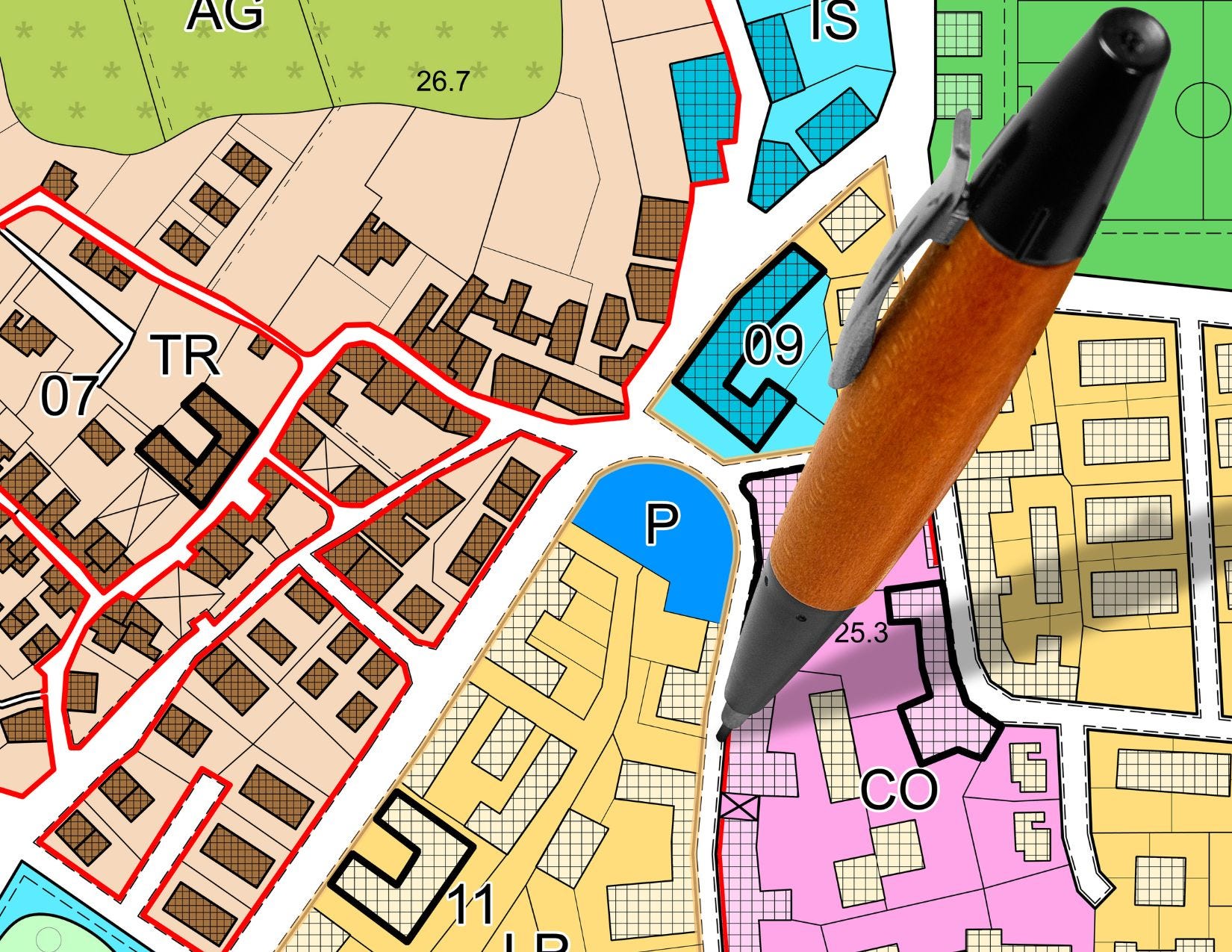
Before I started the cottage court project, I had no idea how much my plans would be shaped — and sometimes stopped cold — by local zoning ordinances. Most cities write their codes with three housing types in mind: single-family homes, townhouses, and large apartment complexes. A cottage court doesn’t fit neatly into any of these boxes. And without an explicit cottage court ordinance, in most jurisdictions, you simply can’t build one.
That leaves you with a choice: move to a place that has the ordinance, or stay put and spend years educating supervisors and advocating for one. Both paths are real. Neither is easy.
What makes a Cottage Court Different?
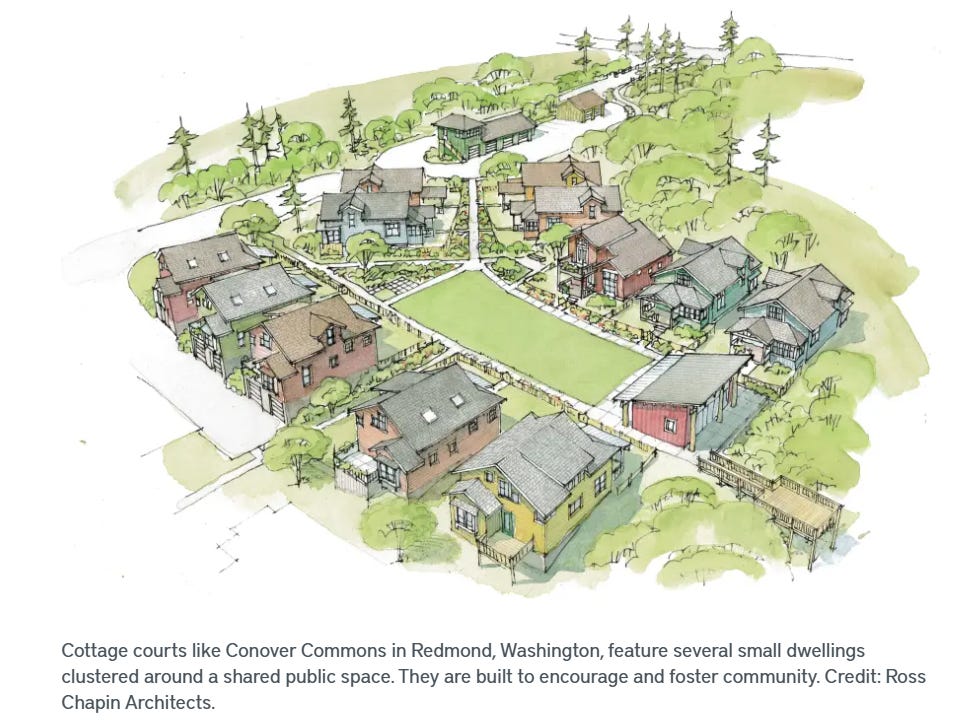
The layout is deceptively simple. Houses face inward toward a shared common green. Each home has a small private yard. Parking is tucked to the side or rear. It feels neighborly, human-scaled, and walkable — everything the New Urbanist movement has been championing for thirty years.
So why is it so hard to build? Because nearly every standard in a typical zoning code was written for a single house on its own lot facing a public street. A cottage court breaks that assumption at every turn.
Key Zoning Obstacles
Road frontage. Most codes require each individual lot to have direct street frontage — in Augusta County, Virginia, that’s a minimum of 50 feet per lot. A cottage court places multiple units on a shared lot accessed by an internal lane, so it fails this test outright.
Minimum lot size. If a code requires 6,000 sq ft per dwelling unit, a 10-unit cottage court needs 60,000 sq ft before you’ve even thought about setbacks or clustering.
Setbacks. A setback is the minimum required distance between a building and a property line. Codes assume a clear front/side/rear relationship to the street. In a cottage court, cottages face an internal courtyard — so “front setback” becomes ambiguous or simply inapplicable.
Use classification. This is the hidden gatekeeper. Cottage courts don’t fit “single-family,” “multi-family,” or “townhouse” categories. Without an explicit cottage court use type in the code, a planner often can’t approve one at all. This is exactly why a dedicated ordinance matters — it creates the use type.
Subdivision and platting. To sell individual cottages as separately owned units, you need a framework that allows shared-lot platting or condominium ownership. Without it, you can build the court but can’t sell the units — which kills the financing model.
Parking minimums. The whole logic of a cottage court is cars at the periphery and a car-free courtyard at the center. But codes typically require a set number of spaces per unit with direct street access, which breaks the layout entirely.
Density and FAR. Density limits can work for or against you. FAR — Floor Area Ratio, the total building square footage divided by lot size — is actually a friendlier measure for cottage courts than a flat units-per-acre cap, because small units on a compact footprint can pencil out well under FAR math.
So Now What?
Here’s the irony I keep running into: many cities that have adopted cottage court ordinances don’t have suitable land to build on. Waynesboro, Virginia is an early adopter of a cottage court ordinance — but has very little available land. Staunton is working on an ordinance and faces the same shortage. Augusta County, which surrounds both cities, has land but sees its primary mission as protecting agricultural land and attracting industry. Change comes slowly there, and I’d rather build than spend years lobbying.
So I’m expanding my search. Next week I’m spending a day in Abingdon, Virginia — a small town in the southwestern corner of the state with a cottage court ordinance already on the books and an affordable housing partnership that recently acquired land through a land trust. They’re planning the town’s first cottage court. It has real potential.
The lesson I keep learning: know your zoning before you fall in love with a piece of land. The ordinance is the foundation everything else is built on — sometimes literally.
(If you’re new here and wondering about cottage courts, start here).
🏘️ Cottage Court Chronicles is free and accessible to all. If you’d like to support this journey, I gladly accept trail snacks (contribute here).
Isn’t Virginia supposed to be allowing tiny house or granny pod type of housing in the near future? Does anything in those changes make the possibility for the cottage court more easily attainable?
Out of date zoning ordinances are at the root of much of the housing shortages around the country. But luck favors the prepared and the persistent!